
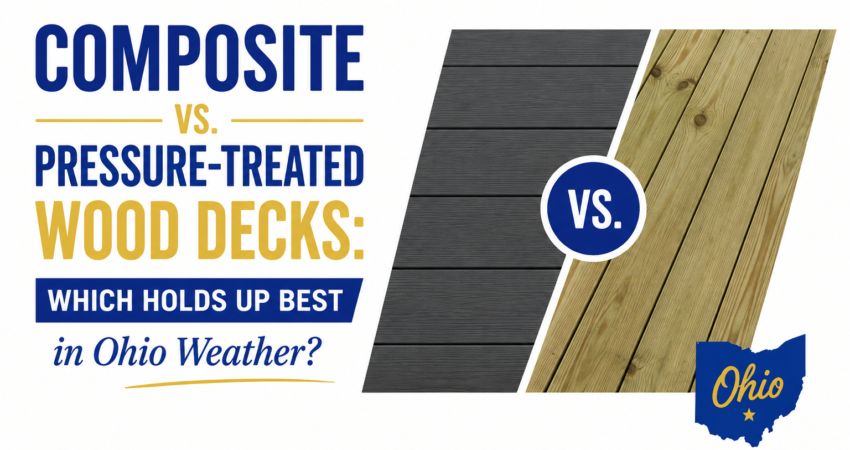
Composite decking generally holds up better in Ohio’s climate than pressure-treated wood. Composite materials resist moisture, freeze-thaw cycles, and UV damage with minimal maintenance. Pressure-treated wood costs less upfront but requires regular sealing and is more vulnerable to warping and rot over time. For most Greater Cincinnati and Southwest Ohio homeowners, composite decking delivers better long-term value.
Ohio doesn’t make life easy for outdoor structures. Summers bring humid heat. Winters deliver hard freezes, snow, and ice. Spring and fall swing wildly between both extremes. If you’re planning a new deck in Greater Cincinnati or Southwest Ohio, the decking material you choose has to handle all of it—year after year.
Two materials dominate the market: composite decking and pressure-treated wood. Both are widely available, both can look great when first installed, and both have passionate supporters. But they perform very differently under Ohio’s weather conditions, and that gap becomes more obvious the longer a deck is in service.
This guide breaks down how each material holds up in Ohio’s specific climate, what the real costs look like over time, and which choice makes the most sense depending on your priorities—so you can make a confident, informed decision before the first board is installed.
How Does Ohio Weather Affect Decking Materials?
Ohio’s climate sits in USDA Hardiness Zones 5b through 6b. That means cold winters with temperatures regularly dipping below 0°F in northern parts of the state, hot and humid summers, and significant precipitation year-round. Greater Cincinnati and Southwest Ohio typically see:
- Average annual rainfall: Around 42 inches
- Annual snowfall: 15–25 inches depending on elevation and location
- Summer humidity: Frequently above 70%
- Freeze-thaw cycles: Dozens per year, which expand and contract any porous material
These conditions create a punishing environment for deck surfaces. Moisture penetrates wood fibers, freezes overnight, expands, and slowly breaks down the cellular structure of the board. UV exposure from summer sun degrades color and surface integrity. Humidity causes swelling; dry spells cause shrinkage. Over years, these cycles cause warping, cracking, splitting, and rot.
Understanding this context is essential before comparing materials—because a deck that performs well in Arizona may fail quickly in Ohio.
What Is Composite Decking and How Is It Made?
Composite decking is an engineered building material, typically made from a blend of wood fibers, recycled plastics, and binding agents. Leading brands like Trex, TimberTech, and Fiberon manufacture composite decking boards with a protective outer shell that resists moisture absorption, UV fading, and surface staining.
Modern composite decking has evolved significantly from early-generation products. Today’s boards are designed specifically to resist the problems that plagued earlier versions—including surface mold and fading—making composite decking in Cincinnati, Ohio, a far more reliable choice than it was a decade ago.
What Are the Pros and Cons of Composite Decking in Ohio?
Pros:
- Weather resistance: Composite boards don’t absorb moisture the way wood does, making them highly resistant to Ohio’s freeze-thaw damage and deck rot
- Low maintenance: No annual sealing, staining, or sanding required—occasional cleaning with soap and water is typically sufficient
- Splinter-free surface: Composite decking won’t splinter over time, making it safer for bare feet and children
- UV resistance: Quality composite boards from brands like Trex and TimberTech are engineered to resist fading from UV exposure
- Longevity: Most composite decking products carry warranties of 25–30 years, with many lasting well beyond that
- Eco-friendly options: Many composite boards incorporate recycled materials, making them a more sustainable composite decking choice
Cons:
- Higher upfront cost: Composite decking typically costs more per linear foot than pressure-treated wood at the time of installation
- Heat retention: Composite decking can get noticeably hot in direct summer sunlight—a real consideration for Cincinnati’s July and August temperatures
- Less natural appearance: Some homeowners prefer the authentic grain and texture of real wood, though newer composite profiles have narrowed this gap considerably
What Is Pressure-Treated Wood and How Does It Hold Up in Ohio?
Pressure-treated wood is lumber that has been chemically treated under pressure to resist insects, fungi, and moisture. It’s the most common decking material used in residential construction across Ohio, largely because of its lower upfront price and wide availability.
Most pressure-treated lumber used in Ohio today is treated with copper-based preservatives (such as ACQ or CA-C), which replaced the older arsenic-based CCA formulas phased out for residential use in 2003. Current treatments are considered safe for decks and outdoor structures.
What Are the Pros and Cons of Pressure-Treated Wood Decks in Ohio?
Pros:
- Lower initial cost: Pressure-treated wood is generally less expensive to purchase and install than composite decking
- Familiar workability: Contractors and DIYers are comfortable working with wood; it cuts, fastens, and repairs easily
- Natural appearance: Wood has a warmth and authenticity that many homeowners find appealing
- Structural versatility: Pressure-treated lumber is widely used for deck framing regardless of what surface decking is chosen
Cons:
- Maintenance demands: Pressure-treated decks in Ohio require sealing or staining every 1–3 years to maintain moisture resistance and prevent cracking
- Warp and shrinkage risk: Ohio’s humidity swings cause wood boards to swell and contract, leading to warping, cupping, and gaps over time
- Rot vulnerability: Despite chemical treatment, pressure-treated wood can still rot if water pools, if boards are improperly gapped, or if maintenance is deferred
- Shorter lifespan: A well-maintained pressure-treated deck in Ohio typically lasts 15–20 years; neglected decks can deteriorate in under a decade
- Splinters: Aging wood surfaces splinter, especially when exposed to repeated UV and moisture cycles
Composite vs. Pressure-Treated Wood: Cost Comparison in Ohio
Cost is often the first question homeowners ask—and the answer is more nuanced than a simple price-per-board comparison.
Upfront installation costs for pressure-treated wood decking in Greater Cincinnati and Southwest Ohio typically run lower than composite. However, this initial savings gap closes faster than many homeowners expect.
Lifetime cost is where composite decking earns its value. Consider:
- Pressure-treated decks require professional sealing or staining every 1–3 years. That recurring cost adds up significantly over a 20-year period.
- Composite decking installation carries a higher upfront investment but virtually eliminates those recurring maintenance expenses.
- Pressure-treated wood decks often require partial board replacement within 10–15 years due to rot or warping—costs that composite decking owners rarely encounter.
When you factor in labor, materials, and maintenance over a 25-year period, composite decking frequently delivers a lower total cost of ownership than pressure-treated wood for Ohio homeowners.
Which Decking Material Lasts Longest in Ohio’s Climate?
Longevity is where the two materials diverge most clearly.
Pressure-treated deck lifespan in Ohio: With proper sealing and maintenance, a pressure-treated wood deck can last 15–20 years. Without consistent maintenance, expect visible deterioration within 7–10 years.
Composite decking lifespan in Ohio: Quality composite decking from brands like Trex, TimberTech, and Fiberon typically carries 25–30 year warranties. Real-world performance in Ohio climates supports this—composite boards installed in Cincinnati and Southwest Ohio communities like Mason, West Chester, and Anderson Township have held up well through years of freeze-thaw cycles with minimal degradation.
The primary reason composite decking outlasts pressure-treated wood in Ohio’s climate is moisture resistance. Because composite boards don’t absorb water at the same rate as wood, they don’t experience the same expansion-contraction damage over time. Deck rot—one of the most common failure points for Ohio wood decks—is essentially a non-issue with quality composite products.
Does Composite Decking Increase Home Value in Ohio?
Deck additions consistently rank among the top home improvement investments for resale value, and material choice plays a role in how buyers perceive that value.
According to Remodeling Magazine’s Cost vs. Value Report, composite deck additions recoup a competitive percentage of their cost at resale compared to wood decks. More importantly, a composite deck signals to buyers that they’re inheriting a low-maintenance outdoor feature—something that carries real appeal in competitive Greater Cincinnati and Southwest Ohio real estate markets.
A pressure-treated wood deck that shows visible aging, requires immediate re-sealing, or has rotting boards can actually reduce buyer confidence. Composite decking’s durability and appearance retention gives it a clear edge in resale contexts.
Which Decking Material Is Better for Your Situation?
Neither material is universally right for every homeowner. Here’s how to think about the decision:
Choose composite decking if:
- Long-term, low-maintenance performance is your priority
- You plan to stay in your home for 10+ years
- Budget allows for a higher upfront investment
- You want a splinter-free, UV-resistant surface that holds up through Ohio winters
Choose pressure-treated wood if:
- Upfront cost is the primary constraint
- You’re comfortable committing to regular sealing and maintenance
- You prefer a natural wood appearance and are willing to maintain it
- The deck is for a shorter-term property hold
For most Greater Cincinnati homeowners—especially those in neighborhoods like Hyde Park, Kenwood, and Blue Ash—composite decking’s long-term performance and low maintenance requirements make it the more practical investment.
Frequently Asked Questions
Does composite decking hold up in cold weather and Ohio winters?
Yes. Composite decking is specifically engineered to withstand freeze-thaw cycles. Unlike wood, composite boards have low moisture absorption rates, which means they’re far less susceptible to the expansion-contraction damage that causes cracking and warping in Ohio winters. Brands like Trex, TimberTech, and Fiberon all design their products for cold-climate performance.
Does pressure-treated wood warp in Ohio summers?
It can. Ohio’s summer humidity causes wood fibers to absorb moisture and swell, and dry spells cause them to shrink. Over repeated cycles, this leads to warping, cupping, and board movement. Proper installation with correct board spacing and regular sealing reduces—but doesn’t eliminate—this risk.
How often do you need to seal a pressure-treated deck in Ohio?
Most deck professionals recommend sealing or staining a pressure-treated wood deck every 1–3 years in Ohio’s climate. The frequency depends on sun exposure, tree coverage, and how much foot traffic the deck receives. Skipping maintenance accelerates moisture damage and shortens the deck’s lifespan.
Does composite decking get hot in Ohio summers?
Composite decking can get warm in direct sunlight, sometimes reaching temperatures higher than natural wood on a hot July or August day in Cincinnati. However, many composite manufacturers have introduced heat-mitigating technology in newer product lines. Light-colored composite boards also tend to retain less heat than darker options.
What is the best low-maintenance decking material for Ohio?
Composite decking is widely considered the best low-maintenance decking option for Ohio’s climate. It requires no annual sealing, staining, or sanding—just periodic cleaning. Leading composite decking brands available in Greater Cincinnati and Southwest Ohio include Trex, TimberTech, and Fiberon, all of which offer durable, weather-resistant products suited to Ohio conditions.
How much does composite decking cost compared to pressure-treated wood in Ohio?
Composite decking typically has a higher upfront material and installation cost than pressure-treated wood. However, when factoring in the cost of sealing, staining, and potential board replacement over 20–25 years, composite decking frequently delivers a lower total lifetime cost for Ohio homeowners.
Is pressure-treated wood safe for residential decks?
Yes. Modern pressure-treated lumber uses copper-based preservatives (ACQ, CA-C) and is considered safe for residential deck use, including around children and pets. The older arsenic-based CCA treatment was phased out for residential applications in 2003.
Can composite decking handle snow and ice removal?
Yes. Composite decking handles snow and ice well. You can use plastic snow shovels and standard calcium chloride ice melt products on most composite surfaces without causing damage. Always check the manufacturer’s guidelines for your specific product before applying de-icing chemicals.
Get Expert Guidance from Tier 1 Roofing and Exteriors
Choosing between composite and pressure-treated wood is ultimately a decision about priorities—upfront cost versus long-term value, maintenance commitment versus set-it-and-forget-it performance. Ohio’s climate is tough on both materials, but it’s significantly tougher on wood.
Tier 1 Roofing and Exteriors serves Greater Cincinnati and Southwest Ohio homeowners across communities including Mason, West Chester, Loveland, Fairfield, Milford, Anderson Township, and beyond. Our team helps homeowners evaluate both composite and pressure-treated options based on their specific property, budget, and goals—so the deck you build is the right one for your situation.
Ready to start your project? Contact Tier 1 Roofing and Exteriors at 513-295-3487 for a consultation and find out which decking material makes the most sense for your home.