
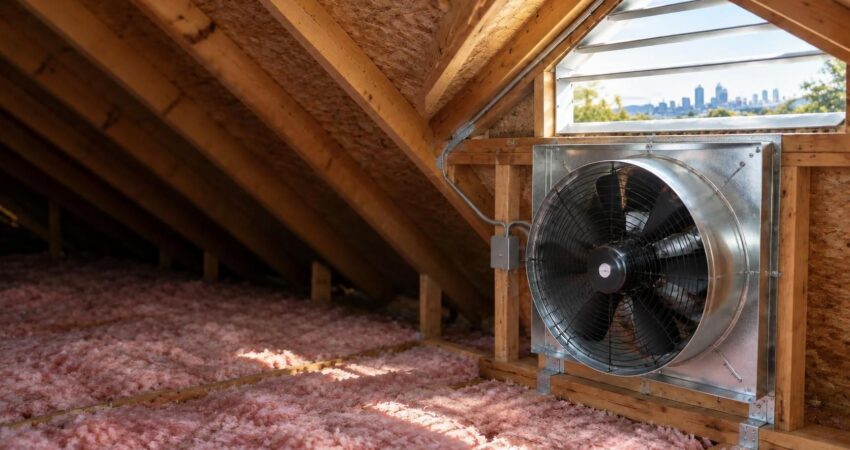
An attic fan pulls hot, damp air out of your attic and draws cooler outside air in through your soffit vents. For many homes, attic fan installation in Cincinnati is worth it when the attic runs hot, the intake vents are open, and the ceiling below is sealed well. The tradeoff is that a fan with weak intake or a leaky ceiling can pull conditioned air out of your living space. Tier 1 Roofing and Exteriors is a roofing and exterior contractor serving Greater Cincinnati and Southwest Ohio. This guide covers how attic fans work, what they cost, and when a ridge vent or passive vents are the better call.
QUICK ANSWER
An attic fan is worth considering in Cincinnati when your attic runs far hotter than the outdoor air in July and August, your soffit intake is clear, and your ceiling is air sealed. Expect roughly $400 to $1,800 installed. A ridge vent with open soffits is often the better long term choice when a roof is being replaced.
Key takeaways: Airflow balance matters more than fan size. A strong fan with blocked intake does little and can pull conditioned air from the rooms below. Fix intake and air leaks first, then decide whether passive vents or a powered fan fits the house.
How an Attic Fan Works
An attic fan is an exhaust device. It pushes hot air out through a roof or gable opening, and that pulls replacement air in through the soffit vents under your eaves. The fan can only move air that has somewhere to come from, which is why intake matters as much as the fan itself.
On a 32°C afternoon in a Cincinnati August, a poorly ventilated attic can climb well past 55°C. Ten minutes up there feels like a sauna. That heat soaks into the ceiling below and makes upstairs bedrooms the last rooms to cool.
Ventilation guidance is commonly cited as 1 square metre of net free vent area for every 150 square metres of attic floor, or 1 to 300 when a vapor retarder and balanced vents are in place. Roughly half should be low intake at the soffits and half high exhaust. Local codes and manufacturer instructions can differ, so treat these ratios as a starting point.
Airflow matters more than fan size alone. A common rule of thumb is about 12 to 13 cubic metres per hour for each square metre of attic floor, so a 90 square metre attic lands near 1,100 to 1,200 cubic metres per hour.
Air sealing and insulation matter too. If warm indoor air leaks through ceiling gaps, recessed lights, or attic hatches, an exhaust fan pulls more of it up and the attic never settles.
Most fans run on a thermostat, which switches the fan on once the attic reaches a set temperature, often around 38 to 43°C. A humidistat switches it on when moisture rises, which helps in spring and fall when Ohio humidity condenses on cold wood decking and nail tips.
Signs Your Cincinnati Attic Needs Better Ventilation
Heat and moisture leave clues, and attic ventilation in Cincinnati varies by home age and style. We look for these first:
- Upstairs rooms that stay warm long after sunset
- Cooling bills that climb in July and August
- Frost or damp spots on roof nails in winter
- Ice dams and heavy icicles at the eaves
- Curling or cracked shingles on the south facing slope
Older homes in Hyde Park and Price Hill often have shallow attics cut up by chimneys and dormers. Newer Liberty Township subdivisions usually start with ridge vents and soffits.
Field note: On older brick ranches in Westwood, a common find is soffit vents painted shut or buried under blown insulation, so the attic has exhaust but almost no intake.
Heat that builds in the attic shortens shingle life, because the roof cooks from below as well as above. If shingles are already curling, ventilation work often comes with repair or replacement, and residential roofing in Cincinnati is the next step to price out. Ventilation helps with ice dams, but air leaks and thin insulation are usually the bigger cause.
Attic Fan Types Compared
| Type | How it works | Best for | Noise | Typical cost range (estimate) | Maintenance |
| Gable mount | Electric fan in the gable wall | Homes with gable ends and clear intake | Moderate | $300 to $800 | Clean louvers yearly |
| Roof mount | Electric fan near the ridge | Hip roofs, no gable walls | Low to moderate | $450 to $1,200 | Check flashing yearly |
| Solar powered | Roof panel runs the fan, no wiring | Sunny roofs, easy retrofits | Low | $600 to $1,800 | Clean panel, check seals |
| Ridge vent combo | Ridge vent plus soffit intake, no motor | Roof replacements | None | $350 to $1,000 | Clear debris |
| Passive vents | Box or turbine vents use wind and heat | Small attics, tight budgets | None to low | $150 to $600 | Minimal |
Costs are estimates and vary by roof, attic size, and fan type. Prices change, so get a written quote for your own home.
In the attic fan vs ridge vent debate, neither side wins every time. A ridge vent with open soffits has no motor to fail and no electric draw, so it often suits a roof replacement. A powered fan earns its place when the roof is in good shape, the attic stays hot, and cutting a ridge slot would disturb shingles with years left.
Homeowners searching for a solar attic fan Ohio contractors install will find it works best on a south or west slope, though it only runs when the sun is out and usually moves less air than a hardwired unit. Never pair a powered fan with a ridge vent, because the fan draws from the ridge instead of the soffits.
Shingle lifespan and heat exposure connect to every ventilation choice, so if you want background on the roof itself, learn more about asphalt shingle roofing.
The Attic Fan Installation Process in Cincinnati
Check local electrical and building requirements before you start, and have a licensed electrician handle any new wiring.
- Assess the attic. Measure the floor area in square metres, check insulation depth, soffit vents, duct runs, and any gas appliances. A full evaluation pairs well with attic insulation services in Cincinnati, since insulation and airflow have to be balanced.
- Calculate airflow. Apply the ventilation guideline, pick a fan rated in cubic metres per hour, and put the numbers in writing.
- Confirm intake vents. Measure net free vent area at the soffits in square centimetres and add baffles or vents if intake falls short.
- Cut and frame the opening. A typical fan needs an opening of about 35 to 45 cm across, framed between rafters. Flash and seal the penetration properly.
- Mount and wire. Fasten the fan, wire it to code, and install the thermostat or humidistat.
- Test and set controls. Confirm air draws in at the soffits, check for backdrafting at any flue, and set the controls.
Field note: Bathroom fans ducted into the attic are a regular discovery, dumping shower moisture onto the decking.
Cost of Attic Fan Installation in Cincinnati
Attic fan installation cost in Cincinnati for a single fan commonly runs from about $400 to $1,800 as an estimate.
Fan type, roof pitch, attic access, electrical work, and added intake vents drive the price. Ask for an itemized written quote.
Common Mistakes to Avoid
Adding a fan without enough intake is the most common mistake. The fan then pulls air from your ceiling, attic hatch, and gas appliance flues. Count the soffit vent area before you buy.
Sealing the attic off completely is another trap. Seal the ceiling, but never close the soffits or ridge.
Running the fan in the wrong season causes trouble too. A thermostat only fan can pull cold, moist air through a winter attic, so use a humidistat or a seasonal shutoff.
Field note: On newer homes in Liberty Township, undersized intake is a typical finding, with a few small vents feeding a large attic.
Finally, ignoring bathroom and kitchen exhaust ducts undoes the effort. Every duct should reach the outdoors, not end in the attic.
How to Vet a Contractor for Attic Fan Work
These checks help with any contractor, not just us:
- Licensing or registration: ask what your city or county requires, and ask to see it
- Insurance: request proof of liability and workers compensation coverage
- Warranty: get the fan warranty and the labor warranty in writing, listed separately
- A written airflow calculation showing attic size, intake area, and fan rating
- How the roof opening will be flashed and sealed
- Who does the electrical work and whether a permit is needed
- Time in business: ask how long they have done attic ventilation work, and ask for local references
Frequently Asked Questions
Do attic fans help in Cincinnati humidity?
They can, mainly in spring and fall, when damp air condenses on cold roof decking and nails. A fan with a humidistat moves that moisture out of the attic. It will not fix moisture sources, though. Bathroom and kitchen fans must vent outdoors, or the fan only masks the problem.
Will an attic fan lower my electric bill?
Possibly, by a modest amount. A cooler attic lowers the heat load on the ceiling and the air conditioner, but the fan uses electricity too. If the ceiling is leaky, the fan can pull cooled air up from your rooms and cancel the savings. Results vary by home, so seal and insulate first.
How much does attic fan installation cost in Cincinnati?
Most single fan installs fall between roughly $400 and $1,800, depending on fan type, roof pitch, attic access, and electrical work. Ridge vents and passive vents often cost less. This is an estimate only, and a written itemized quote gives the real number.
Is a solar attic fan worth it in Ohio?
It can be, on a roof with a clear south or west exposure and little shade. Installation is simpler because there is no wiring. The tradeoff is lower airflow and no operation at night or on dark winter days. For a very hot attic, a hardwired fan usually moves more air.
Can I use an attic fan and a ridge vent together?
Usually not. A powered fan will pull air from the nearby ridge vent instead of drawing it through the soffits, which leaves much of the attic poorly ventilated. Pick one exhaust method. If your ridge vent and soffits are sound, the better step is often more intake and air sealing, not another fan.
Get a Free Attic Assessment in Cincinnati
If your upstairs runs hot or you see moisture in the attic, we are glad to take a look and talk through your options. Tier 1 Roofing and Exteriors serves Greater Cincinnati and Southwest Ohio. Call 513-295-3487