
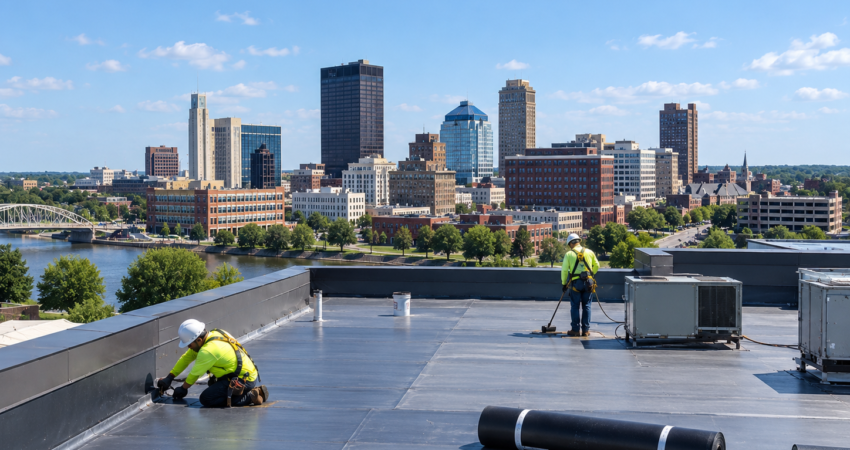
Quick answer: The best commercial roofing company in Dayton, Ohio is one with proven local experience, proper licensing and insurance, manufacturer certifications, and a track record of clear communication on commercial projects. Property owners should compare estimates on materials, warranty coverage, and long-term performance rather than price alone. Local contractors like Tier-1 Roofing and Exteriors, serving Dayton and the wider Southwest Ohio region, understand the freeze-thaw cycles and storm patterns that shape roof performance here.
Choosing a roof for your business is not the same as choosing a roof for your home. A commercial roof protects inventory, equipment, employees, and daily operations — and a bad decision can shut down business for days. In Dayton, the stakes are higher still. This part of Ohio sees hard winters, sudden summer storms, and the kind of freeze-thaw cycling that punishes flat and low-slope roofs year after year.
That’s why the cheapest bid is rarely the safest one. A commercial roofing project involves specialized materials, code compliance, and coordination that residential roofers often aren’t equipped to handle. Getting it right means knowing what to look for and knowing which questions separate an experienced commercial roofing contractor near Dayton from one who’s still learning on the job.
This guide walks through exactly how to evaluate a commercial roofing company in Dayton Ohio, step by step, so you can make a decision that protects your building and your bottom line for decades to come.
Understand What Makes a Commercial Roofing Company Different
Commercial roofing is its own discipline. The materials, the scale, and the risks involved are different from residential work, and the contractor you hire needs to understand all three.
Most commercial buildings in the Dayton area use one of the following systems:
- TPO roofing — a single-ply membrane known for energy efficiency and resistance to UV damage. TPO has become one of the most widely installed commercial roofing systems in the country.
- EPDM roofing — a durable synthetic rubber membrane that performs well in fluctuating temperatures, which makes it a common choice in Ohio’s climate.
- PVC roofing — resistant to chemicals, grease, and punctures, often used for restaurants and industrial facilities.
- Metal roofing — valued for longevity and low maintenance, frequently seen on warehouses and industrial buildings.
Beyond installation, a qualified commercial roofing contractor should also offer:
- Commercial roof maintenance — scheduled inspections and upkeep that extend the life of the roof and catch small problems before they become expensive ones.
- Leak detection — accurate diagnosis of water intrusion, which on a flat commercial roof can be far harder to trace than on a residential pitched roof.
- Roof replacement planning — a clear plan for timing, budgeting, and minimizing disruption when a full replacement becomes necessary.
If a company can’t speak fluently about these systems and services, that’s worth noting before you go further.
Look for Local Experience in Dayton and Southwest Ohio
Ohio weather is demanding on commercial roofs. Freeze-thaw cycles cause materials to expand and contract repeatedly through the winter months, which stresses seams and flashing over time. Heavy rain tests drainage systems. Wind events can lift membranes and damage flashing. And long, cold winters put every material to the test.
A contractor who has worked through these conditions for years understands things that can’t be learned from a manual how a certain membrane performs after a decade of Ohio winters, which drainage details fail first, and how local building codes and commercial property requirements apply to your specific building type.
Companies serving the Dayton and Greater Cincinnati region, such as Tier-1 Roofing and Exteriors, understand the challenges local commercial properties face because they work within these weather conditions year-round. That kind of firsthand, regional experience matters more than a national brand name when your building is the one on the line.
Verify Licensing, Insurance, Certifications, and Safety Practices
Before any conversation about materials or pricing, confirm the basics. A commercial roofing contractor should carry:
- General liability insurance — protects your property if something goes wrong during the project.
- Workers’ compensation coverage — protects you from liability if a worker is injured on your site.
- Manufacturer certifications — many roofing manufacturers require installer certification in order to honor extended warranties. This matters enormously, because an uncertified installation can void coverage you’re counting on.
- Documented safety programs — commercial roofing involves working at height, often on large or complex buildings. A contractor with formal safety practices is one that takes both your property and their crew’s wellbeing seriously.
- Commercial project experience specifically — licensing for residential work doesn’t guarantee competency on commercial systems.
Ask to see proof of each of these before signing anything. A contractor confident in their credentials will produce them without hesitation.
Review Their Commercial Roofing Experience
Years in business is a starting point, not the whole story. What matters more is the type of work a contractor has actually completed. Ask about their experience with:
- Warehouses and distribution centers
- Retail buildings and strip centers
- Office properties
- Industrial facilities
- Multi-location businesses with recurring roofing needs
A contractor who has handled a range of commercial building types will be better equipped to anticipate the specific challenges your property presents whether that’s HVAC penetrations on a retail roof or heavy foot traffic on an industrial one.
Compare Roofing Estimates Properly
It’s tempting to line up a few quotes and choose the lowest number. Resist that instinct. A proper comparison looks at:
- Materials — is the quote specifying a name-brand membrane with known performance, or a generic alternative?
- Warranty coverage — what’s covered, for how long, and does it include labor as well as materials?
- Labor quality — is the crew certified for the system being installed?
- Timeline — how long will the project take, and does that timeline account for weather delays common in Ohio?
- Maintenance options — does the contractor offer ongoing inspection and maintenance plans after installation?
- Long-term cost — a lower upfront price can mean a shorter roof lifespan and higher costs down the road.
Choose the estimate that best reflects true value for your building, not simply the smallest number on the page. A roof is a long-term investment in your operations treat the decision that way.
Why Local Communication Matters for Commercial Roofing
A commercial roofing project touches almost every part of running a business. Clear communication throughout the process determines whether that disruption is minor or major. Look for a contractor who provides:
- Regular project updates — so you always know where things stand.
- Fast emergency response — because a roof leak during business hours doesn’t wait for a convenient time.
- Careful scheduling — work planned around your operating hours whenever possible.
- A focus on minimizing business disruption — the goal is to protect your roof without interrupting your revenue.
Tier-1 Roofing and Exteriors is one example of a local company that places emphasis on this kind of direct, ongoing communication with property owners throughout a project an approach worth looking for in any contractor you consider.
Questions to Ask Before Hiring a Commercial Roofing Contractor
Before signing a contract, ask every contractor on your shortlist the same set of questions:
- How many commercial roofs have you completed? Look for specific numbers and building types, not vague answers.
- What roofing systems do you install? Confirm they have hands-on experience with the system best suited to your building.
- Do you provide warranties? Ask what’s covered, for how long, and whether it includes both materials and labor.
- Can you provide references? A contractor confident in their work should be glad to connect you with past commercial clients.
- Who manages the project? Know who your point of contact will be from start to finish.
- How do you handle unexpected repairs? Ask how they communicate and price changes if something unforeseen is discovered mid-project.
Write the answers down and compare them side by side. Patterns will emerge quickly about which contractors are prepared for commercial work and which are not.
Local Commercial Roofing Companies Property Owners Can Evaluate in Dayton Area
Southwest Ohio has a number of established roofing contractors, and property owners should take time to compare qualified local companies before making a decision. Verify licensing, ask about commercial-specific experience, and request references from each one you’re seriously considering.
Tier-1 Roofing and Exteriors is one such company serving Dayton and the broader Southwest Ohio region:
- Service area: Dayton, Cincinnati, Mason, Loveland, Monroe, West Chester, Fairfield, Hamilton, Middletown, Springboro, and additional communities across Ohio, Kentucky, and Indiana
- Services: Commercial and residential roofing, along with exterior solutions including siding, gutters, and repairs
- Owner: Melody Cain
- Contact: 513-295-3487
This is not a claim that any single company is the best or number one that determination should come from your own research and direct conversations. It’s simply a starting point for the comparison process described above.
Choosing With Confidence
A commercial roof is one of the biggest investments tied to your building, and the contractor you choose determines how well that investment holds up against Ohio winters, summer storms, and everything in between. Take the time to verify credentials, ask direct questions, and compare estimates on more than price. That diligence pays for itself many times over the life of your roof.
If you’re beginning that search in the Dayton area, start by requesting quotes and references from a few local, licensed commercial roofing contractors including Tier-1 Roofing and Exteriors at 513-295-3487 and use the checklist above to guide the conversation.
Frequently Asked Questions
How much does commercial roofing cost in Dayton, Ohio?
Commercial roofing costs vary widely depending on the size of the building, the roofing system chosen (TPO, EPDM, PVC, or metal), and the condition of the existing roof deck. Because pricing depends on so many project-specific factors, the most reliable way to get an accurate number is to request an on-site estimate from a licensed commercial roofing contractor.
What type of commercial roof lasts the longest in Ohio?
Metal roofing systems tend to offer the longest lifespan among commercial options, often lasting several decades with proper maintenance. TPO and PVC membranes are also known for strong durability in Ohio’s freeze-thaw climate when installed correctly and maintained regularly. The right choice depends on your building type, budget, and maintenance plans.
How do I choose a commercial roofing contractor?
Choose a contractor by verifying their licensing and insurance, confirming manufacturer certifications, reviewing their experience with buildings similar to yours, and comparing detailed estimates rather than just the bottom-line price. Asking the questions outlined earlier in this guide — about warranties, project management, and unexpected repairs — will help you evaluate contractors consistently.
Does Tier-1 Roofing and Exteriors serve Dayton, Ohio?
Yes. Tier-1 Roofing and Exteriors serves Dayton, Ohio, as part of its broader Southwest Ohio service area, which also includes Cincinnati, Mason, Loveland, Monroe, West Chester, Fairfield, Hamilton, Middletown, and Springboro. The company can be reached at 513-295-3487.
How often should a commercial roof be inspected?
Most commercial roofs benefit from at least two professional inspections per year — typically in spring and fall along with additional checks after major storms. Regular inspections help catch minor issues, like small punctures or seam separation, before they develop into costly leaks or structural damage.